
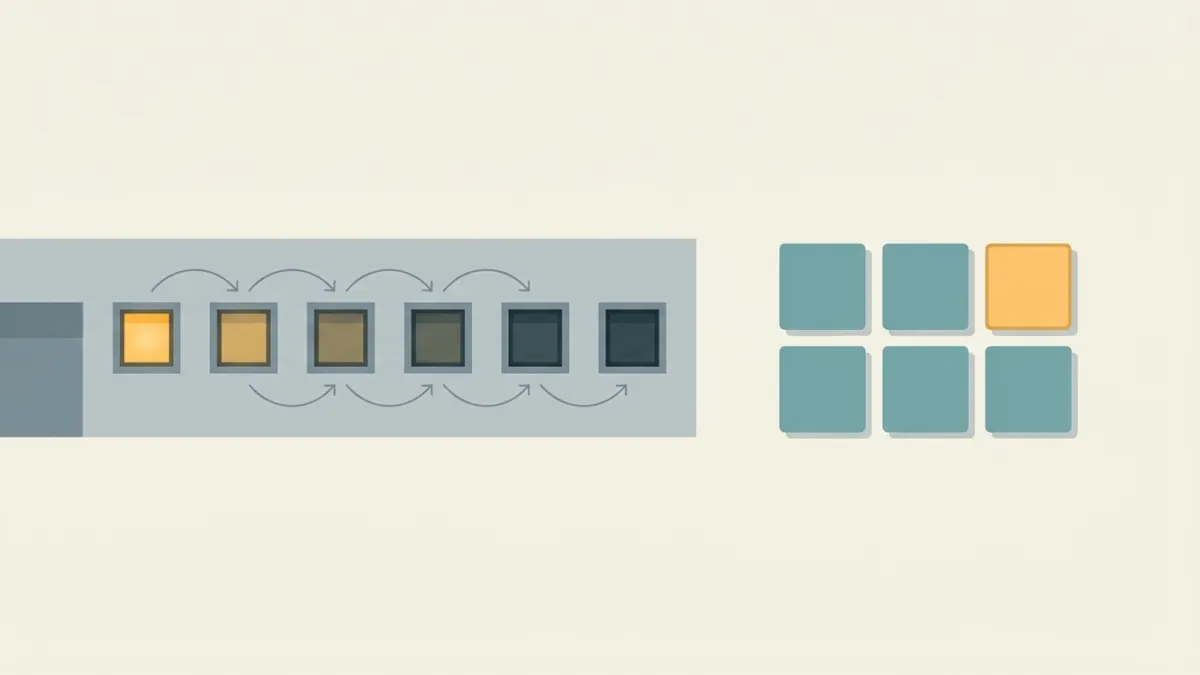
A rise in market rents gets into the US consumer price index (CPI) through a sample: each rented home in the sample is priced once every six months, and only one of six groups of homes is priced in any given month.
Short answer
The US Bureau of Labor Statistics (BLS) splits its rent sample into six panels, prices every unit twice a year and turns each six-month change into a monthly one with a sixth root. Because most rents in the sample are continuing rents, a rise in market rents can reach the index only when a sampled unit comes up for pricing. The BLS factsheet gives no figure for the resulting lag.
How the US CPI measures rent
The CPI has two big housing-cost indexes, and both are built from rents. BLS says the CPI Housing Survey interviews renters only: "Owner-occupied units are not interviewed in the CPI Housing Survey; the Housing Survey sample contains only rental units."
The first index, rent of primary residence, follows the rents of those units directly. The second, owners’ equivalent rent (OER), covers homes that people own. For an owner-occupied unit, BLS says, most of the cost of shelter "is the implicit rent that owner occupants would have to pay if they were renting their homes, without furnishings or utilities". BLS treats owned homes as capital goods, distinct from the shelter service they provide, so owned homes are not priced at all. OER is calculated from the rents of rented units, with different weights and adjustments from the rent index.
That makes the pace of the rent sample matter well beyond tenants. In Table 2 of the October 2026 CPI release, which gives relative importance as of September 2026, shelter is 35.238, rent of primary residence 7.707 and OER 25.853. Each figure is the item’s percentage of the total consumer spending covered by the CPI basket. OER therefore weighs about 3.4 times as much as rent (our calculation). For how such weights work, see what is in the basket behind inflation.
Six panels, six months
BLS "collects rent data from each sampled unit every 6 months" and divides each area’s rent sample into six subsamples called panels. Panel 1 is priced in January and July, panel 2 in February and August, and so on through the year. In any month, therefore, one panel is priced.
For each area, BLS divides the average rent of the current month by the average rent of the same units six months earlier. The result is the six-month relative. For rent, "the sixth root of this relative is the 1-month change in rent for index area α", in BLS’s wording; OER is computed the same way from its own relative.
A model case shows the arithmetic. If a panel’s rents were 3% higher than six months earlier, the six-month relative would be 1.03 and its sixth root about 1.0049, a monthly change of roughly 0.49% (our calculation). Six monthly steps of that size compound back to the 3% rise.
BLS also adjusts rents for quality changes, such as an additional bedroom or bathroom, and for age. Rents are collected from the same units every six months, so "each time the CPI observes the rent of a sample unit, it is 6 months older"; to account for this aging, "an age-bias factor is applied to the previous rent".
How a rise in market rents enters the index
Three features of the design shape how a rise in market rents enters the index.
- Pricing twice a year. A unit’s rent enters the index only when its panel is priced, which can be up to six months after a rise in market rents.
- Monthly steps. The sixth root turns a six-month change into a one-month change. A rise that built up over half a year is entered as a monthly step, not as a six-month jump.
- Mostly unchanged rents. BLS says: "Most rents included in the sample are continuing rents, and only a minority of observations are rents which have changed since the previous observation period."
Two cases
The October 2026 US release. BLS reported on 10 November 2026 that the shelter index rose 0.3% in October, after rising 0.4% in September, and accounted for "over thirty percent of the monthly all items increase". Owners’ equivalent rent rose 0.3% and rent 0.2%. These are seasonally adjusted monthly changes (Table 2 of the release). Rent and OER are each built from the panel priced that month. Shelter is wider: rent and OER together are 33.560 of its 35.238 relative importance (our calculation), and the rest is other components.
The euro area. Eurostat’s HICP manual (2024 edition) says that actual rentals "should cover all types of properties, including private, public and social rental units, as well as new and existing rental contracts". One often used approach is to have the household report how much it pays in rent. Another is to obtain the rents from landlords. Rental price changes that coincide with a change of tenant "should be reflected in the index". The manual also says imputed or estimated rentals for owner-occupied housing are "not within the scope of the HICP, as they do not involve any monetary transaction". The euro-area index therefore has no counterpart to OER. That is a difference of scope, not of speed: neither the BLS factsheet nor the Eurostat manual says which index follows market rents faster. The HICP rent index is the one used in rent versus wages in ten EU countries. For what housing-cost measures cover more widely, see what housing affordability actually measures and owning versus renting.
Glossary
- CPI. The consumer price index. This text covers the US CPI for All Urban Consumers, published by BLS.
- Panel. One of six subsamples of an area’s rent sample. Each panel is priced twice a year, in months six apart.
- Six-month relative. The average rent of the current month divided by the average rent of the same units six months earlier.
- Owners’ equivalent rent (OER). The implicit rent that owner-occupants would have to pay if they were renting their homes, without furnishings or utilities.
- Continuing rent. A rent that has not changed since the previous observation of the same unit.
- Seasonally adjusted. A monthly change from which the regular seasonal pattern of the month has been removed.
- Relative importance. An item’s percentage of the total consumer spending covered by the CPI basket.
- HICP. The EU’s harmonised index of consumer prices, the euro-area counterpart of the CPI.
What to watch
The next release is the BLS CPI for November 2026, scheduled for Thursday 10 December 2026 at 8:30 a.m. ET. In it, read the rent and OER lines of Table 2 and compare their seasonally adjusted monthly changes with October’s 0.2% and 0.3%. One month is one panel, so a single reading says little about the trend in market rents.
Sources & method
The method of the US rent and OER indexes is taken from the BLS factsheet on owners’ equivalent rent and rent (last modified 13 February 2026), which gives the weights as of December 2025. The October 2026 figures, the relative-importance weights as of September 2026 and the seasonal adjustment of the monthly changes are taken from the BLS news release of 10 November 2026 (text and Tables 1 and 2); the date of the next release is the one the release states. The euro-area passages quote section 12.4 of Eurostat’s HICP Methodological Manual, 2024 edition. The 3.4 ratio, the 33.560 sum and the 0.49% monthly step are our own arithmetic, from the figures named above.
Checked: 12 November 2026, against the BLS factsheet, the BLS CPI news release of 10 November 2026 and the Eurostat manual.
Source: BLS, How the CPI measures changes in rent and owners’ equivalent rent; BLS, Consumer Price Index news release, October 2026; Eurostat, HICP Methodological Manual, 2024 edition.